AI adoption is outrunning data protection. Closing the gap takes a new way of building policy, not more headcount.
Enterprises are adopting AI tools faster than their DLP programs were ever built to handle. For many security leaders the question is "How do we protect data flowing through the AI tools we've already approved, without slowing the business?"
Consider a CISO whose organization approves a handful of AI coding agents in a single quarter with a two-person data security team. With rushed policies that generate too many false positives. The problem isn't bad tools. AI creates new data risk faster than people configuring policies by hand can respond.
The constraint has moved
Classification technology has matured, with ML-augmented detection built to understand data in context rather than just match patterns. The new constraint is the configuration layer: turning a team's understanding of risk into working policy. That work is manual and depends on experts, and it can't keep up with AI adoption. Regulatory and compliance requirements add more work, because PCI DSS, HIPAA and GDPR weren't written with generative AI in mind.
The organizations that are winning at data security don't have the most policies. They have policies that stay current.
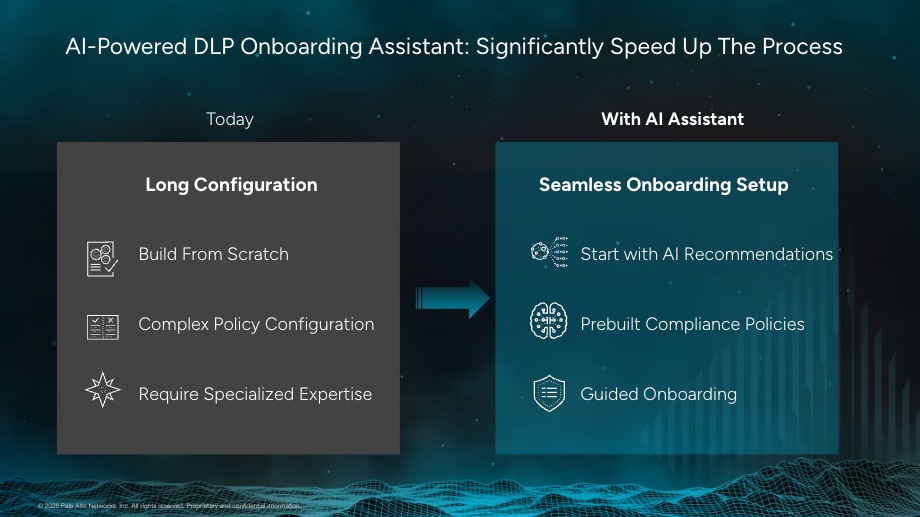
This is where AI belongs in data security. Not as another detection engine, but as an assistant that understands your environment and does the mechanical work between your judgment and an active policy. You shouldn't need to know what a proximity keyword is to protect your data.
What makes an assistant trustworthy
Every leader will ask the same question: Can I trust AI with enforcement? We think it comes down to four principles:
- Humans stay in the loop. The assistant confirms your organization's context before proposing anything, and you approve the full policy before anything goes live.
- Context comes before templates. A bank operating across the EU and APAC needs a different starting point than a US hospital.
- Monitor before you enforce. Policies start by observing, allowing you to enable blocking only when the data shows they're accurate.
- Multi-channel coverage from the start. Network, SaaS, endpoint and email are handled together, not as four separate projects.
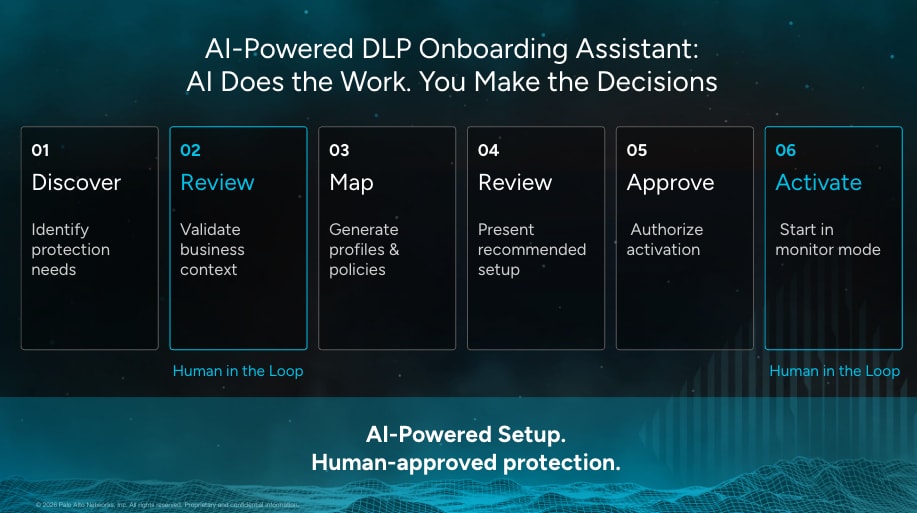
The road ahead: day one should be the easiest day
For two decades, deployment has been one of the most persistent challenges for any DLP program. Onboarding typically meant months of classifier research, regulatory mapping and policy tuning before protection was active anywhere. Many programs stalled right there, and many others never started.
The next era of DLP will help reverse that: onboarding can stop being a project and become more of a conversation. A security leader describes the organization and what matters most. Within one session, a comprehensive, context-aware policy is ready for review. The expertise that used to take months to assemble will be there from the first prompt.
That changes what a DLP program is. When getting started takes a conversation, every new AI tool, business unit or regulation is simply onboarded again, in minutes rather than quarters. Protection stops trailing adoption and starts keeping pace with it. And the security team's time moves from building policy to acting on what their policies reveal.
At Palo Alto Networks, we're building toward that future, where protecting your most sensitive data starts with a single question. Ready to make DLP onboarding simple? Talk to a DLP expert today to gain our insight into how AI can reshape your experience.
Forward-Looking Statements
This blog contains forward-looking statements that involve risks, uncertainties and assumptions, including, without limitation, statements regarding the benefits, impact, or performance or potential benefits, impact or performance of our products and technologies or future products and technologies. Any unreleased services or features (and any services or features not generally available to customers) referenced in this or other press releases or public statements are not currently available (or are not yet generally available to customers) and may not be delivered when expected or at all. Customers who purchase Palo Alto Networks applications should make their purchase decisions based on services and features currently generally available.