Organizations are racing to adopt AI across every part of the business. AI copilots are assisting employees, AI agents are automating workflows, developers are embedding LLMs into applications and teams are experimenting with models faster than security can track them.
But as AI adoption accelerates, a new reality is emerging. Most organizations no longer fully understand the scope of their AI ecosystem — what AI assets exist, what sensitive data powers them, who can access them, and which AI systems are actively interacting with the business.
And that’s becoming one of the biggest security challenges of the AI era.
AI Applications Are Only Part of the Story
Securing AI applications is important, but AI risk extends beyond a single app or interface. Today’s AI ecosystems include:
- AI models and inference endpoints
- AI agents and autonomous workflows
- AI-generated code and software libraries
- Vector databases and AI pipelines
- Public and private AI services
- AI workloads running in cloud environments
- Employee use of unsanctioned AI tools
- Endpoints interacting with AI systems
The problem is that these environments evolve rapidly through a spate of ungoverned activity and outcomes. Teams experiment, models get cloned, agents become overprivileged, APIs remain connected, developers test new frameworks, and business units adopt public AI services without security approval.
In fact, as we discussed in our recent blog on shadow AI workloads, AI usage increasingly emerges, often outside traditional governance processes, across workloads, containers, images and runtime environments. And as a result, organizations over time accumulate a layer of unmanaged AI assets that silently expand the attack surface.
The Hidden Risk: Inactive and Unmanaged AI Assets
One of the most overlooked risks in AI security is model and agent proliferation.
Many organizations are discovering they have AI models, endpoints, agents and AI-related workloads that are no longer actively used but remain connected to sensitive data, cloud services, APIs or identities. Because security teams concentrate on production applications, these inactive assets tend to fall outside governance. Attackers, however, don’t care whether an AI system supports an active business process. They care whether it provides access.
The abandoned model reachable through overprivileged identities, as well as the idle inference endpoint connected to sensitive datasets and the forgotten AI agent tied to privileged service accounts all become viable attack paths. As adversaries operate at machine speed, dormant AI assets expand the attack surface without announcing their presence.
The abandoned model reachable through overprivileged identities, as well as the idle inference endpoint connected to sensitive datasets and the forgotten AI agent tied to privileged service accounts all become viable attack paths. As adversaries operate at machine speed, dormant AI assets expand the attack surface without announcing their presence.
Visibility doesn’t give security teams the control they need. Organizations must understand AI activity, including which assets remain connected, communicating and capable of exposing the business.
Why Activity Analysis Changes the Game
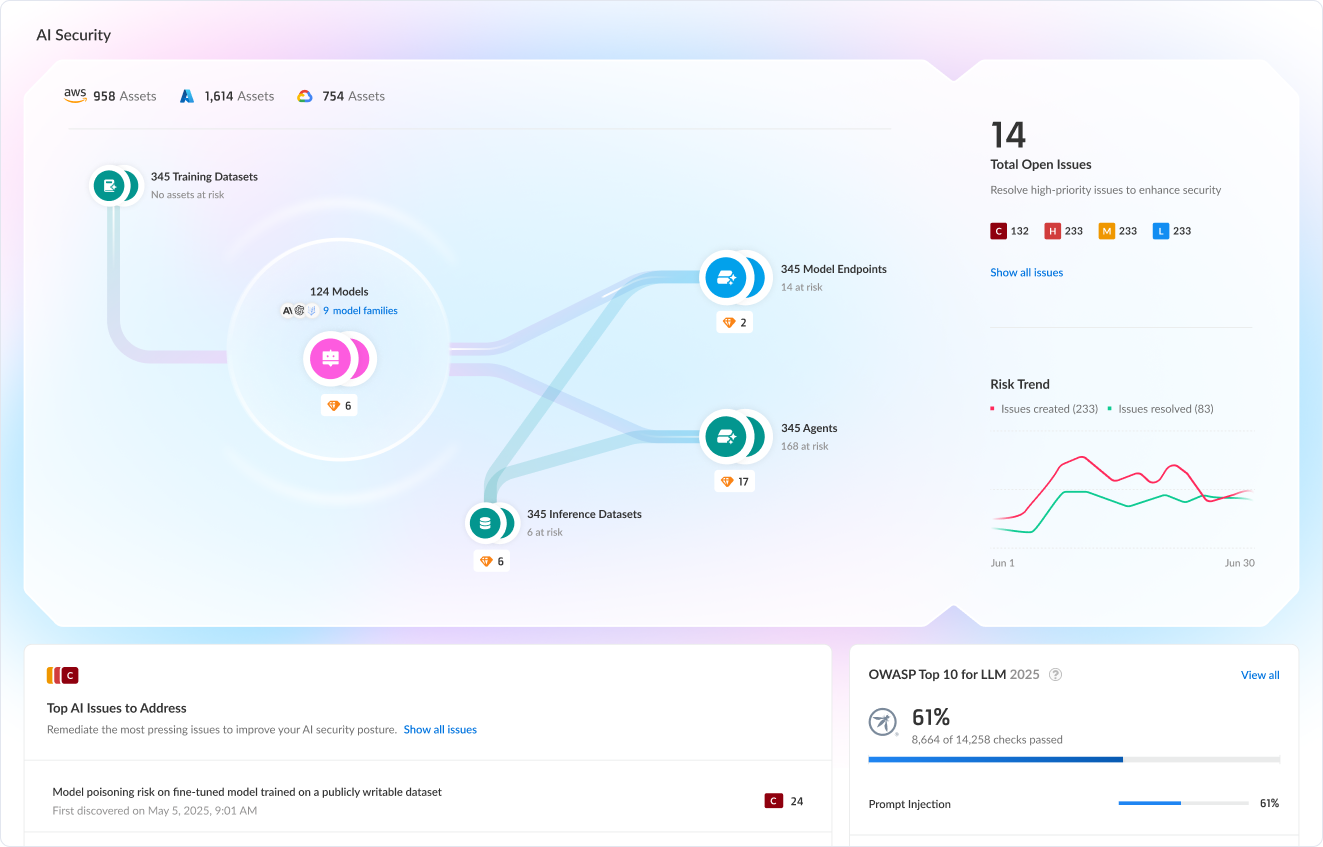
Static inventory merely shows what exists. Cortex Cloud AI-SPM goes further by showing which AI assets are active, connected, communicating and interacting with sensitive data.
Activity analysis gives security teams the operational context required to separate dormant experimentation from production AI systems, sanctioned use from shadow AI activity, and isolated assets from systems tied to sensitive business data. It also helps teams distinguish low-risk experimentation from exploitable attack paths.
Activity context becomes essential as AI adoption spreads through informal experimentation across teams. Without it, security teams may know an asset exists without understanding whether it matters, where it connects, or how much risk it introduces.
Take for example:
- A developer testing an external AI API from an unmanaged endpoint
- A business team uploading customer data into unsanctioned AI tools
- An AI agent accessing cloud resources with excessive permissions
- A dormant model still communicating with sensitive storage repositories
Without activity context, these risks are often invisible.
By continuously analyzing AI behavior, communications and exposure patterns, Cortex Cloud AI-SPM helps organizations prioritize the AI risks that matter.
Understanding the Data Behind AI
AI security is fundamentally a data security problem.
Every model, agent, copilot and AI workflow depends on data that may be sensitive, regulated or business critical. Cortex Cloud AI-SPM integrates deeply with DSPM capabilities to give security teams a richer understanding of:
- What sensitive data powers AI systems
- Where the data resides
- Who can access it
- How exposed it is
- Whether sanctioned or shadow AI systems use it
With data context, organizations can move beyond generic AI visibility and assess actual business risk. Instead of merely identifying an AI model, security teams can determine whether the model interacts with regulated data, whether exposed identities can access the underlying datasets, whether sensitive information flows into public AI systems, and whether vulnerable AI workloads create attack paths to critical data.
Context like this becomes critical in the age of frontier AI, where attackers increasingly target the intersection of identities, AI systems and sensitive data.
AI Security Must Extend to Runtime and Endpoints
Since organizations also need visibility into runtime behavior and endpoint interactions, AI security cannot stop at just posture management. Cortex Cloud extends AI security across the full lifecycle. It does so by combining AI-SPM with Prisma AIRS runtime capabilities and AI-DR to help organizations detect, investigate and respond to live AI threats, malicious behavior, risky runtime activity and AI-driven attacks across cloud environments.
At the same time, endpoint visibility plays a growing role in understanding how employees interact with AI systems, how shadow AI spreads, and where sensitive data may be exposed through AI usage.
As AI adoption accelerates, endpoint coverage becomes increasingly critical for securing real-world AI interactions taking place across the enterprise.
Operationalizing AI Security at Scale
Security teams are overwhelmed by fragmented, disconnected alerts and complex investigation workflows. Reliable AI security simplifies operations rather than adding yet another silo.
Cortex Cloud AI-SPM helps operationalize AI security with unified dashboards and built-in KPI visibility that provide immediate understanding of:
- AI asset exposure
- Shadow AI usage
- Inactive models and agents
- Sensitive data exposure
- Identity-related AI risk
- Runtime findings and prioritization
Instead of forcing analysts to manually investigate graphs and piece together disconnected signals, Cortex Cloud surfaces actionable insights and business-relevant risk context directly within the platform.
Security teams can also use the solution to leverage Cortex AgentiX natural language capabilities to ask questions such as:
- Which AI agents currently have access to regulated customer data?
- Show me inactive AI models connected to sensitive storage.
- Which data and AI assets are communicating with unsanctioned AI services?
- What AI assets create the highest-risk for attack paths on sensitive data?
Combined with Cortex’s integrated SOC capabilities, organizations gain a unified operational experience for identifying, prioritizing and responding to AI-driven risk.
AI Security Requires a Unified Platform
AI is changing how organizations operate, how software gets built, how data moves, and how attackers find opportunity.
Securing AI applications requires visibility across the AI ecosystem — and that includes models, agents, workloads, identities, endpoints, runtime activity and the sensitive data behind it all.
As AI environments become more dynamic and autonomous, security teams need more than inventory. They need activity context, data intelligence, runtime protection and risk prioritization that reflects how AI systems behave across the business.
Cortex Cloud AI-SPM is built for that operating reality.
To learn practical strategies for identifying and mitigating AI-related risks across your cloud environments, download the white paper, Steps to Mitigate AI Security Risks in Your Cloud Environment.