Enterprise AI is gaining a new class of models. Alongside the frontier systems that are built to reason and generate, a faster, leaner class is entering production. These models are built to decide rather than write.
The Emergence of Decision Models
Large language models are designed to generate prose. When one is asked to judge an incoming request, such as whether an email is urgent or whether an agent should be permitted to run a database tool, it produces open-ended text to express the answer. For routine operational choices, that approach is slow and costly.
Decision models take a different path. TypeSafe AI's Jev introduced the category in September 2026, and open-source implementations such as Laya followed within days. A decision model is an encoder coupled with context: it reads and understands many languages but writes in none. When provided with a bounded question and a defined set of options, it selects one option and returns a confidence score. Because it does not generate text, it operates at a fraction of the cost and latency of a frontier model performing the same task. Decision models are designed for the high volume of small, repeatable decisions an agent makes as it completes its work.
Smarter Distribution for Efficiency
Frontier models are exceptionally capable at what they do. But not every task they handle requires that capability. Routing a request, evaluating whether an action is permitted, and classifying an incoming signal are bounded decisions with a fixed set of outcomes, and running them through a frontier model is both slower and more expensive than it needs to be.
Decision models like Jev handle exactly this class of work faster, at a fraction of the cost. Offloading bounded decisions to a decision model frees frontier models to focus on the steps that actually require open-ended reasoning, making the overall system more efficient without any loss in capability.
Context Is Still the Threat Surface
A decision model can only return a choice from a fixed list, so its output is well formed by design. A well-formed answer can still be wrong, and a calibrated score indicates correctness only under the conditions the model was calibrated for. Security team cannot confirm whether the information the model received was authentic in the first place. This opens room for context poisoning attacks.
Attackers do not need to compromise model weights or defeat guardrails through direct prompt manipulation. They can conceal instructions within a document an agent retrieves through retrieval-augmented generation, or plant a forged approval in the application state a decision model evaluates. A decision model supplied with manipulated context will return a clean, confident verdict that is poisoned. Because its output can trigger an agentic action without significant evidence for human review, the downstream consequences are greater.
Context integrity includes five dimensions a security team should govern.
| Dimension | Core Governance Question | Verification Mechanism |
| Authenticity | Did the context originate from the claimed source? | Cryptographic provenance and identity signatures |
| Integrity | Was the data altered in transit or storage? | Payload hashing and audit logs |
| Recency | Is the information current enough to rely on? | Time-stamping and retention policies |
| Authority | Is the source permitted to influence this action? | Role-based access control and entitlement validation |
| Semantic truth | Are the factual claims in the context accurate? | Independent multi-source validation and human review |
Governing the Model Path
Consider a forged approval planted in an agent's application state. Ask the decision model whether the action is allowed, and the forged approval shapes its answer. A check that reads poisoned context cannot be relied on to catch it. The control point must sit outside the model, on the path that requests and responses travel.
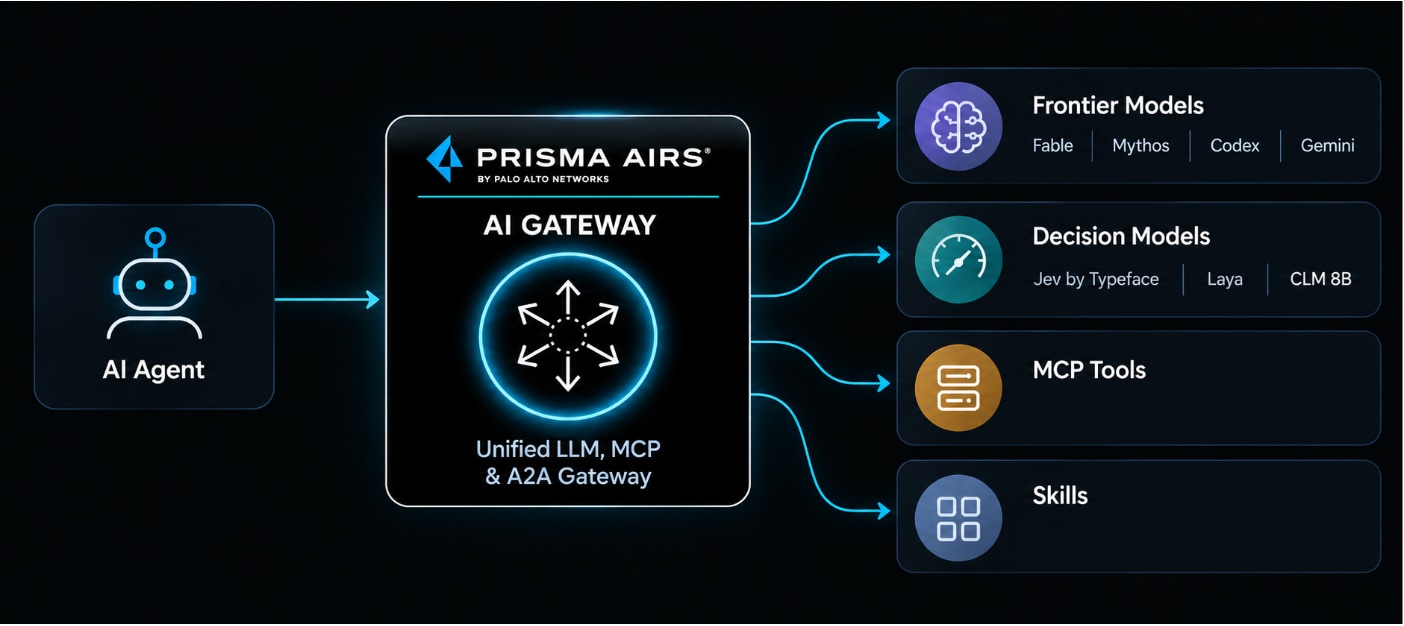
The AI gateway sits in front of frontier reasoning models, decision models, and other tools.
This is the role of an AI gateway, such as the Prisma AIRS AI Gateway. Operating as an independent control plane on the model path, it:
- Can route each request to the appropriate model, directing bounded decisions to a decision model and open-ended work to a frontier model based on the context of the request;
- Enables inspection of prompts, retrieved content, and application state passed to the model for injection and concealed instructions;
- Helps implement identity policies that neither reasoning nor decision models can override;
- Records each request and decision for audit.
An AI gateway inspects and governs the model path. It does not, on its own, establish the provenance, freshness, or truth of every source. Those responsibilities belong to the wider architecture described above: signed provenance, entitlement validation, and independent verification for claims the gateway cannot settle. What the gateway provides is a single location where the trust assumptions on that path become visible, testable, and enforceable.
One can now access Jev on Typesafe as a model via the new /decisions route natively in Prisma AIRS AI Gateway.
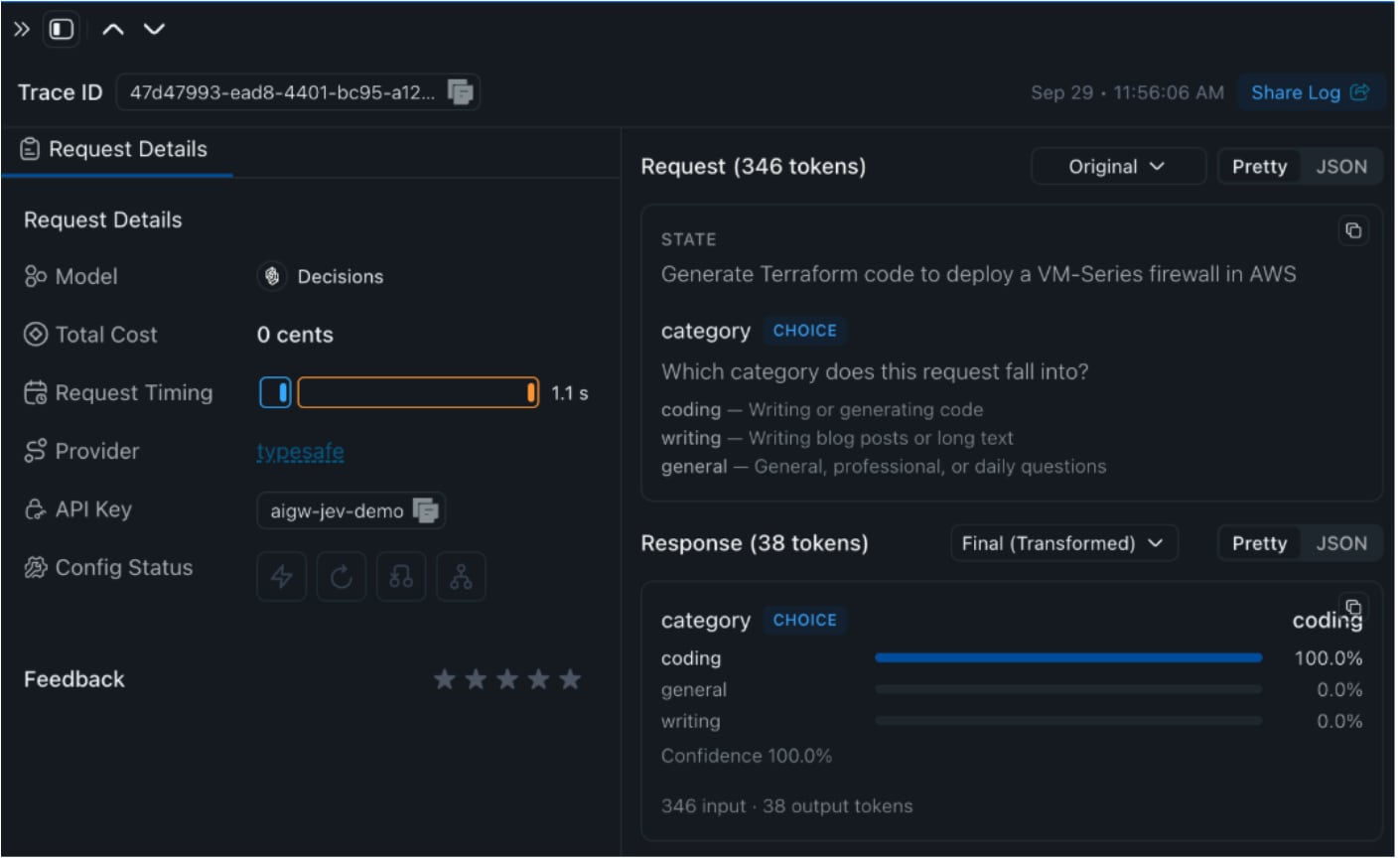
Questions for Enterprise Security Leaders Deploying Decision Models
As organizations move from conversational assistants to always-on multi-agent systems, decision models will drive their efficiency and frontier models will drive their capability. Both depend on trusted inputs.
Inspecting context and applying policy outside the model is already how the industry defends against prompt injection and adversarial attacks. Decision models add a new dimension to this exposure, because downstream agents can act on their verdicts without review, at low cost and high volume.
CIOs bringing decision models into agentic workflows should be able to answer three questions:
- Which tasks are my frontier models handling today that a decision model could take on?
- Where do downstream agents act on a decision model's verdict without human review?
- What inspects the context those models read, independently of the models themselves?
Models will continue to evolve. Securing the path that feeds them and auditing the context will remain a durable responsibility of enterprise security.
Watch our webinar to see how Prisma AIRS innovations and the Palo Alto Networks–Anthropic partnership help address the security challenges of the AI coding in the enterprise.